
NTCIP 1202 CoordSyncPoint: Ambiguity of First Coordinated Phase

NTCIP 1202 v03B published in October 2023, Section 5.5.7.6 specifies the coordination sync point for a given pattern. A related definition for the unit coordination sync point can be found at Section 5.5.16.
Particularly, the “patternCoordSyncPoint” object is defined in Section 5.5.7.6 as follows:
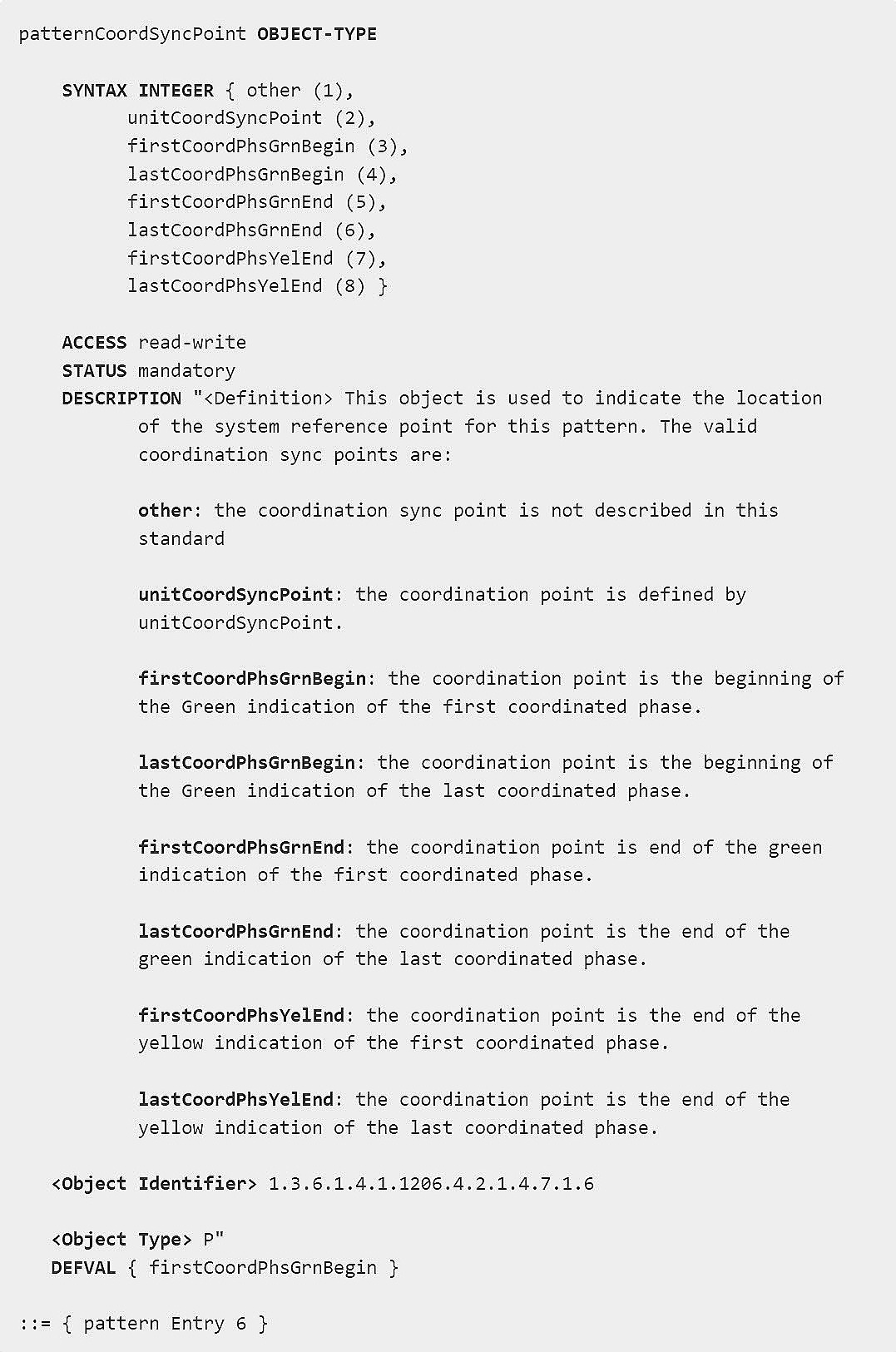
The objects in question defines several possible event points that can serve as pattern coordination sync points:
At the
beginning of the greenintervalAt the
end of the green interval(equivalently, the start of the yellow change interval)At the
end of the yellow change interval(equivalently, the start of the red clearance interval)
While these events are clearly delineated, the implementation of this object hinges on a precise definition of the “first” coordinated phase and the “last” coordinated phase. This is particularly relevant for NEMA-TS2 actuated traffic signal controllers with a ring-barrier structure, where a user can designate one coordinated phase per ring. In multi-ring systems, multiple coordinated phases can exist, which raises an important question:
What criteria should be used to determine the “first” and “last” coordinated phases among these?
The Core Issue: Defining the “First” Coordinated Phase
Intuitively, at first glance, one might assume that the "first" coordinated phase is simply the one that starts its green interval first. However, this seemingly straightforward interpretation introduces ambiguity, especially when the sync point are not anchored at the beginning of the green interval. In such cases, it becomes unclear how to define the "first" phase. This ambiguity opens the door for different vendors to interpret the standard in varying ways, leading to inconsistencies in implementation.
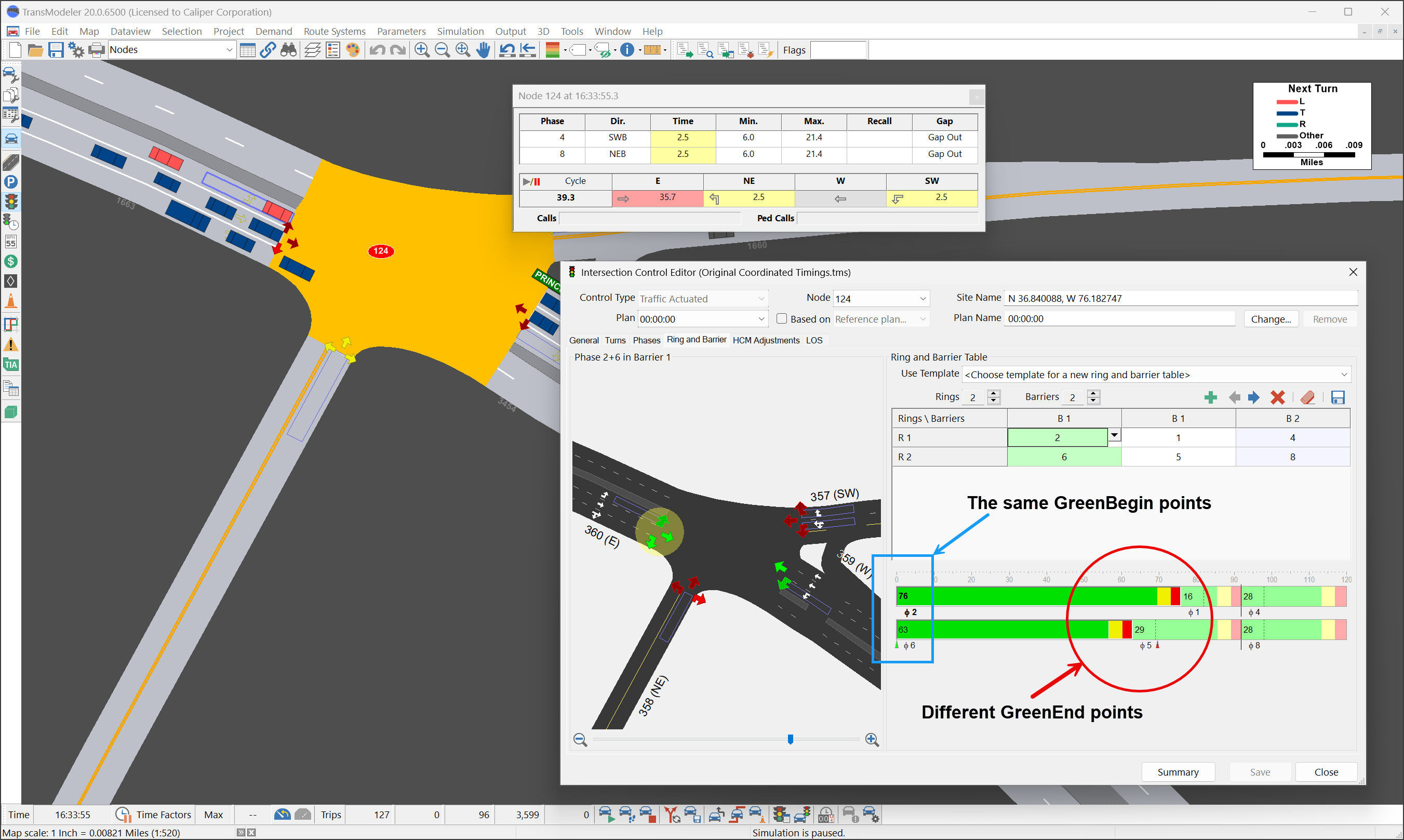
Consider a phasing diagram where Phase 2 and Phase 6 are the designated coordinated phases, and both are leading phases in their respective rings. If the pattern sync point is set to “firstCoordPhsGrnBegin” , it doesn’t matter which phase is deemed “first”, as the sync point would be the same regardless of the phase chosen.
However, the situation becomes more complex when the sync point is set to “GreenEnd” or “YellowEnd”. In this scenario (see the Figure below), vendors might have different interpretations for determining which phase should be considered first. Some might choose to prioritize the phase with the earliest sync point, i.e.,. Phase 6, even though Phase 2 starts green at the same time as Phase 6. This results in inconsistent implementations.
The Need for Standardized Interpretation
This lack of clarity highlights a gap in the current standard. When different vendors are left to interpret the "first" coordinated phase in their own way, the fundamental purpose of the standard—ensuring interoperability—can be undermined.
In corner cases like the one described, where the sync point is set to GreenEnd or YellowEnd, the standard should provide explicit criteria for determining the "first" coordinated phase to ensure uniformity across vendor implementations.
Conclusion
The NTCIP 1202 v03B standard represents significant progress within its series. However, there remain opportunities for further refinement in future versions, particularly to address the (albeit small) corner cases, such as the one described.